

Budapest
With in hours after a murderous Russian attack on a hospital for children with cancer in Kyiv, Vladimir Putin’s delegation to the United Nations in New York organized a lunch to mark its chairmanship for the month of July of the Security Council. Its menu: Chicken Kyiv. For a moment I thought this had to be a joke, tasteless, but a joke. Then I found out that I was wrong, that once again I had a meeting with Russian cruelty. My thoughts raced back to that awful day in August 1991, when US President Bush, during a stop-over in Kyiv, warned the Ukrainians against, what he called their “suicidal nationalism”, implying that Ukraine should stay with Russia, a non-starter, which was buried three months later, when 92 percent of the electorate voted for the independent and sovereign Republic of Ukraine, a great moment in our common Europe’s history. To this day the Bush-speech, remembered as his Chicken Kyiv-spech, raises the question: did the President also see the war of the united colonies, fought from 1775 to 1783 against the English crown, as a folly, as suicidal nationalism. Or was he capable of double thinking and double speaking?
Ten years of Russian war, bloody and extremely destructive, has produced a cynicism almost unimaginable for civilized people. Bitter jokes float through the poisoned air. Do our domestic putinists have a bad taste in their mouths? Do we need to hear from them once again that the killing of seriously sick children, their doctors and nurses would not have happened, if only Ukraine, stubbornly fighting Ukraine, had been pressured to make peace with Russia? In this line of reasoning the guilty ones are those, who defend themselves against their attackers.
The attack on the children’s hospital in Kyiv was deliberate and precise. The X-101 air-to-ground cruise missile is a highly sophisticated weapon, whose use of preceded coordinates ensure an almost faultless hit at the intended target. As such this attack was one more war crime, politically. Politically a terrorist act with the purpose of terrorizing innocent children and innocent parents and of sending a message to the NATO-summit in Washington: we will do whatever suits us. The thinking is fascist. Pure and simple.
A friend and colleague, whom I respect very much – especially because we often disagree and can discuss our differences peacefully – writes to me that I am wrong to call Russians fascists. The Russians are not fascists, they are Russians and will remain so, he claims, regardless of the West. Actually, Somehow I agree. I don’t know as much about Russians as he does, but I have been to Russia several times since a first train trip in 1970 from Helsinki by way of St. Petersburg, in those days Leningrad, Moscow and several Siberian cities to the Pacific coast, from where I continued on a Russian ship to Japan and Hong Kong.
I have had Russian friends and especially Russian girlfriends, who amazed me with their readiness to lie. One of them coldly asked me, over lunch in Rome, to marry her a week before her wedding to an Arab diplomat. I still meet young, educated Russians – refugees or immigrants – who shamelessly insist on Russia’s right to rule over so-called inferior peoples such as Ukrainians, Armenians, Georgians, Uzbeks, and others. Again and again I hear, rather sheepishly, that Russia needs a strong man. Sure, there are brave individual protesters, but where are the massive demonstrations against Putin’s dictatorship and his atrocities in the Kaukasus, in Eastern Europe, the Middle East and Africa? Where are the waves of civil disobedience, which in the late 2oth and early 21st century changed the fate of Europe and of Ukraine within Europe? Even the White Russians dared to challenge their autocrat. In Russia there is emptiness, a deafening silence, cowardice, Russianism being fascism.
This attitude or mentality can be seen in Russian public debates – or their absence – through generations. A few critics might try to turn their immovable country in the direction of Europe and European democratic values. For their efforts they are killed, they disappear in the camps of the regime, or they flee abroad. If one hesitant step forward is permitted, two determined steps backward will follow, organized by an Eurasian elite, who sees Europe as a threat to Russia, to Holy Russia, whose main task is to fight decadent and vulgar Europe. In this historic sequence, characterized by czars, communists, and Putinists, Russians remain fascists, silent and introspective, not noisy and not just a passing phenomenon like the European fascists of the 20th century.
Vladimir Putin’s mouthpieces in the West should tell us about the kind of peace they envisage. Should Ukraine, colonized, oppressed and exploited by Russia for 300 years, deliver up to ten millions of its population, up to a third of its territory and all of its political sovereignty to Russia? Can Europe, Ukraine included, trust any peace, made with Putin’s Russia, which bombs hospitals, kindergartens, churches, museums, apartments blocs and supermarkets, and which under Putin has violated the 1948 UN Charter, the 1975 Helsinki Treaty on Security and Cooperation in Europe, and the 1994 Budapest guarantees of Ukraine’s territorial integrity?
Adolf Hitler in Germany committed suicide, and his body disappeared in the flames of Berlin. In Italy, Mussolini was shot and his dead body hung feet up on a gas station in Milan. Stalin died in his bed and received a colossal state funeral, surrounded by genuine national grief, leaving the impression that Russian fascism is a state of mind, not a curable nervous breakdown like German or Italian fascism.
This is what was observed by a great Danish intellectual, Georg Brandes, who in 1887 gave a number of lectures at the universities of Sct. Petersburg and Moscow on European literature. The following year he published a book, called “Impressions from Russia”, in which he argues that Western culture reaches Russia only in fragments, and that the Russians have the rulers they deserve: “The more nobly and persistently (an advanced Russian) claims for his country the benefits of justice, humanity, and freedom, the clearer it becomes to him that these can only be achieved, when the national inclinations, which have prevailed for centuries, are fought against incessantly and mercilessly. He feels that in Russia it is impossible at the same time to wish for progress, courage, and the strengthening of a national feeling.”
Indeed, Russians remain Russians, in my opinion born fascists. It makes no sense to believe in their westernization or democratization. What does make sense is that the West, by supporting the Ukrainians, pushes Russia out of Europe, into its own, for us terrible world.
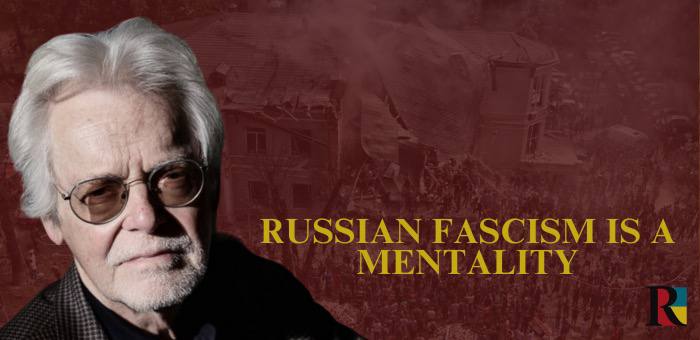
By Per Nyholm
*These opinions are solely those of the author. The Ukrainian Review takes no position and is not responsible for the author’s words.
Per Nyholm has been a Danish journalist since 1960. He is based in Austria and is a columnist and foreign correspondent at the Jyllands-Posten, a liberal Danish daily newspaper.
Tetiana Stelmakh adapted this text for The Ukrainian Review.