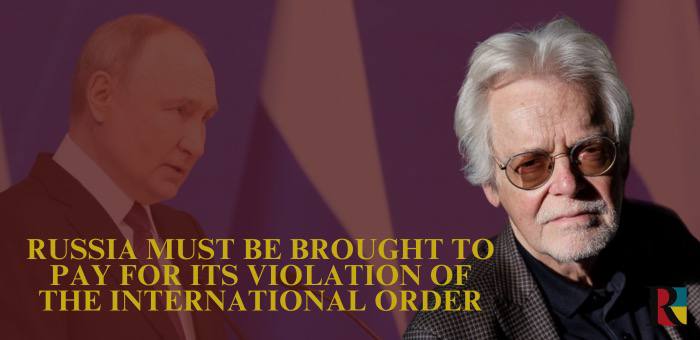


After the bombing of Poltava, Danish journalist and commentator Per Nyholm asks Russia’s ambassador in Copenhagen, Vladimir Barbin: “Do you sleep well, Mr. Ambassador, knowing that the head of state you represent is charged with war crimes and crimes against humanity and risks—if he shows up in a decent country—being extradited to the UN’s war crimes prison outside The Hague?
“There can be no question of a Russian victory. A defeat in Ukraine would constitute a life-threatening defeat for our democracy and our entire European way of life” — Danish Prime Minister Mette Frederiksen, recently in Prague.
What is needed now in the West is a decisive move from the idea of defence to the idea of victory.
Vienna
Poltava in central Ukraine is a large, quiet city, shaped by more than 300 years of Russian imperialist rule—very Russian in appearance, the cool classicism employed by the tsars, then vulgarised by Josef Stalin. This Stalin, who in the name of communism, starved four million Ukrainians to death in the 1930s and sacrificed nine million Ukrainians in his so-called Great Patriotic War against Nazi Germany, with which he collaborated closely until 1941, when, much to his surprise, he was attacked by Hitler, his fellow dictator in Berlin.
I first passed through Poltava 25 years ago. I wanted to see the battlefield where Peter the Great defeated Mazepa and Sweden’s Charles XII in 1709, one of the most important battles of the Great Northern War. Thousands of Danes from the recently conquered Skane countries fell there, and thousands more disappeared into Russian captivity. The Swedish king’s calculation was as merciless as that of Stalin: for him, a good Dane was a dead Dane.
Later, I passed by with an excellent Ukrainian friend, Yevhen. He is now at the front, working with drones. We visited his grandmother in Poltava, a lovely old lady whom I sketched in my 2023 book “On the Road in the Land of Blood” (available to any serious publisher in Ukraine). In Poltava, I also knew an elderly surgeon engaged in saving severely wounded soldiers at the hospital, which was recently bombed together with a nearby military academy, killing over fifty people. Once again, I felt the cold horror of war, including the extreme brutality of Russian fascism. And I thought that if the West had admitted Ukraine into NATO, fully or partially, in 2008, when Vladimir Putin, the Russian leader, attacked Georgia, we could have avoided not only Ukraine’s tragedy but this entire Third World War, now unfolding from the Arctic over Eastern Europe to the Near East.
Denmark has a good reputation in Ukraine, thanks to the firm stance taken by Prime Minister Mette Frederiksen and Foreign Minister Lars Løkke Rasmussen in the face of Putin´s aggression. We provide Ukrainians with material support, money, diplomatic backing, and, on the quiet, with a few brave men and women. I do not know much about the government’s motivation, but I would like to believe that, besides the political calculation—Denmark’s strategically exposed position: the Baltic Sea, shipping lanes, and large parts of the Arctic—there is a portion of idealism: democratic Denmark stands in solidarity with democratic Ukraine.
I cannot help but think that if Ukraine’s most important allies had acted quickly and strategically sound in 2014 when Russia annexed Crimea and occupied large parts of Donbas, we could have avoided Ukraine’s tragedy, which is also the tragedy of the West. The lesson in 2024 is a repetition of the lesson in the 1930s when Hitler grabbed territory after territory until 1939 when the democracies had enough and acted. Had the democracies put the then-unprepared Nazi leader in his place already in 1933, we would likely have been spared World War II.
Given the Russian missile attack on Poltava, I feel compelled to ask Putin’s ambassador in Copenhagen, Vladimir Barbin, if he still believes, as he has claimed on numerous occasions, that the war against Ukraine is going according to plan. Is it planned, Mr. Ambassador, that Russian soldiers have so far murdered or maimed perhaps 300,000 Ukrainians? Is it planned that about half a million young Russians have lost their lives or limbs in a war now being justified with the obvious nonsense that NATO countries are trying to destroy Russia? Do you sleep well, Mr. Ambassador, knowing that the head of state you represent is charged with war crimes and crimes against humanity and risks—if he shows up in a decent country—being extradited to the UN’s war crimes prison in the Netherlands? In peaceful Denmark, are you troubled with any thoughts about what could happen to you and your family?
There is this early autumn quite some speculation, necessary in my opinion, about Ukraine’s chances of winning a war, which Putin intended to win in a couple of weeks and which is now approaching its fourth year, recently supplemented with the interesting detail that Ukrainian troops have captured well over 1,000 square kilometres of the Kursk region in Russia. My personal conviction is that Ukraine and Europe—with or without the U.S. after the presidential election in two months—have all the resources, human, material and economic, needed to secure a Ukrainian and European victory and that Russia, for precisely this reason – its lack of resources – is doomed to lose within the next three or four years. What is needed now in the West is a decisive move from the idea of defence to the idea of victory.
At a recent security conference in Prague, Mette Frederiksen, the Danish Prime Minister, said the following: “There can be no question of a Russian victory. A defeat in Ukraine would constitute a life-threatening defeat for our democracy and our entire European way of life.” Quite right. Military aid, of both a defensive and offensive nature, must be increased, and the Ukrainians must be enabled to use the weapons delivered as they see fit in the occupied parts of Ukraine and in Russia (excluding undisputed civilian facilities).
It cannot be said clearly enough: Russia started the war in Ukraine, which is a war against Europe, and Russia must be punished for its awful violation of the international order.
By Per Nyholm
*These opinions are solely those of the author. The Ukrainian Review takes no position and is not responsible for the author’s words.
Per Nyholm has been a Danish journalist since 1960. He is based in Austria and is a columnist and foreign correspondent at the Jyllands-Posten, a liberal Danish daily newspaper.
Tetiana Stelmakh adapted this text for The Ukrainian Review.