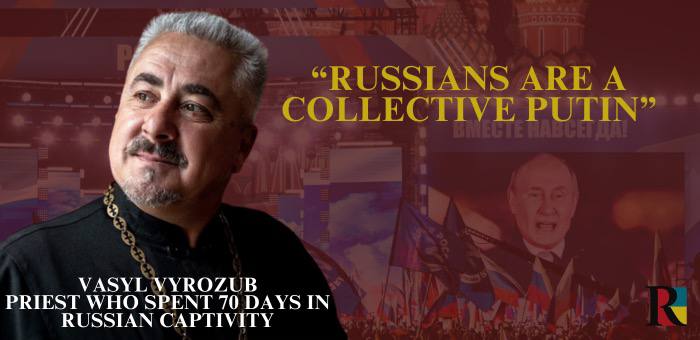


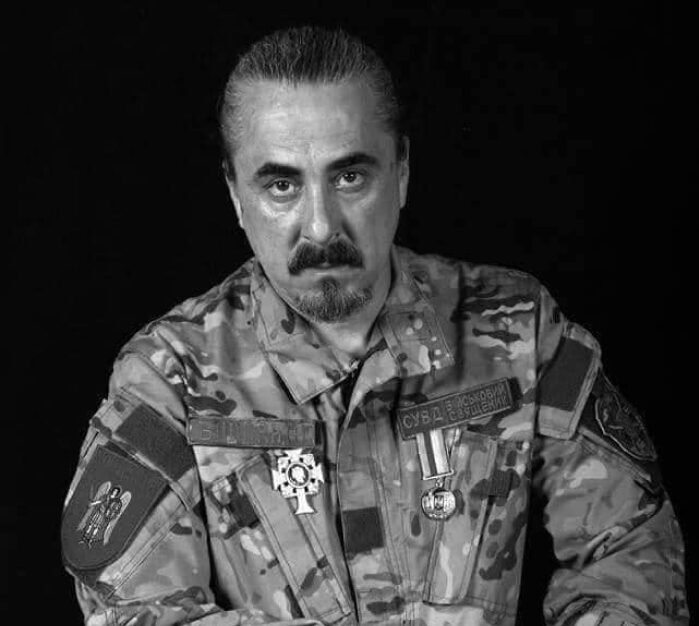
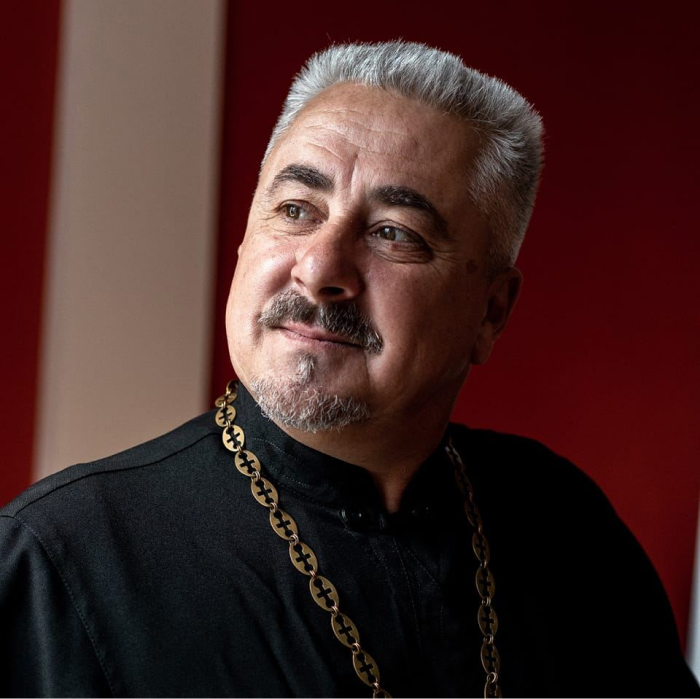
The story of the Ukrainian chaplain, and rector of the Holy Trinity Church of the OCU in Odesa, Father Vasyl Vyrozub, who spent 70 days in Russian captivity, is a litmus test of this brutal war. It is a testament to the heroism and indomitability of the Ukrainian spirit, as well as to the cunning and cruelty of the enemy. The Ukrainian Review is sincerely grateful to Father Vasyl for agreeing to this emotional interview.
Father Vasyl is a native of the city of Borshchiv, Ternopil region. In his youth, under the influence of his cousin, he decided to devote his life to serving God. After the army, he graduated from the theological seminary and was a priest in his native Ternopil region for 13 years. In the mid-2000s, Vasyl Vyrozub decided to change his life and move to the Crimea. However, by the will of fate, he ended up in Odesa: while on the roadtraveling, his car was robbed at a roadside cafe. The clergyman turned to the Odesa bishop, who offered him a ministry in the Holy Trinity Church.
Father Vasyl actively participated in the Revolution of Dignity (Euromaidan). After the outbreak of war in eastern Ukraine, he regularly went to the front line to give communion, confess, and serve liturgies. Like many people, he did not fully believe in a full-scale war with Russia. However, February 24, 2022, came.
The beginning of the Great War
K.G: What was your emotional reaction to the enemy’s full-scale invasion? Did you expect this to happen?
V.V: I didn’t expect it; I was rather afraid [that it could happen—ed.] Many people thought that Putin’s generals, his political elite, or his billionaire sponsors would not allow him to attack Ukraine because everyone understood that it would be a big problem for Russia.
My first thoughts were mixed: it was absurd, he couldn’t do that! I had this feeling for about the first half of the day. At about 4 o’clock, I called my friend who was in the military and asked: What is this shelling? He replied: that is the Russians made a breakthrough in Chongar and Putin started the war. It was a shock for me. His entourage, the Russian society… I repeat I was sure he would be stopped. Today, we have all realised that they all are a collective Putin.
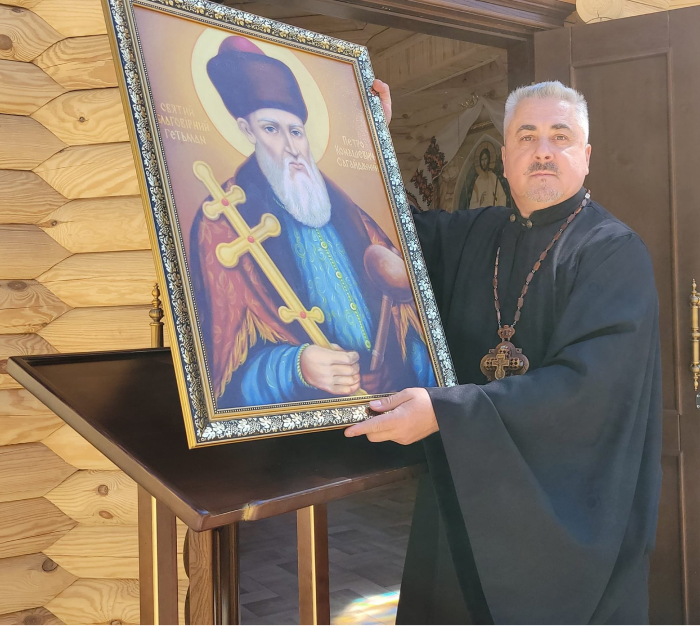
There was no time to bring his thoughts into harmony with himself. Father Vasyl went to the headquarters of the district territorial defence, where, in the first days of the war, he helped to make Molotov cocktails. For the priest, the 25th of February was a harbinger of an extremely important mission – to save people in the occupied territory.
How the humanitarian mission to Zmiinyi Island (Snake Island) was interrupted
V.V: In the morning, a captain of the Ukrainian Navy called me and asked if I could go to Zmiinyi Island [an island in the Black Sea in Ukraine’s territorial waters. It was occupied on the first day of the war – ed.] and evacuated two civilian lighthouse observers and 13 dead border guards [as it turned out later, the soldiers survived and were taken as prisoners by Russia – ed.] More precisely, he asked who I could recommend to send there. I volunteered to go there myself. I called the chaplain of the 35th Brigade, Oleksandr Chokov, later two more people joined me, a third chaplain and a medic, I grabbed bags for evacuating the 200s [in military jargon, cargo-200 was used in the USSR and is used in most post-Soviet countries in referring to a dead soldier – ed.]
On the way, we saw a damaged ship sending out SOS, but no one was there. Then we returned to refuel. At 11 p.m., we were moving again towards Zmiinyi. And at 7 a.m., we received a command from the Moskva [the Moskva missile cruiser, the flagship of the Russian Black Sea Fleet. It was shot down by the Ukrainian Defense Forces on April 13, 2022, and sank the next day – ed.].
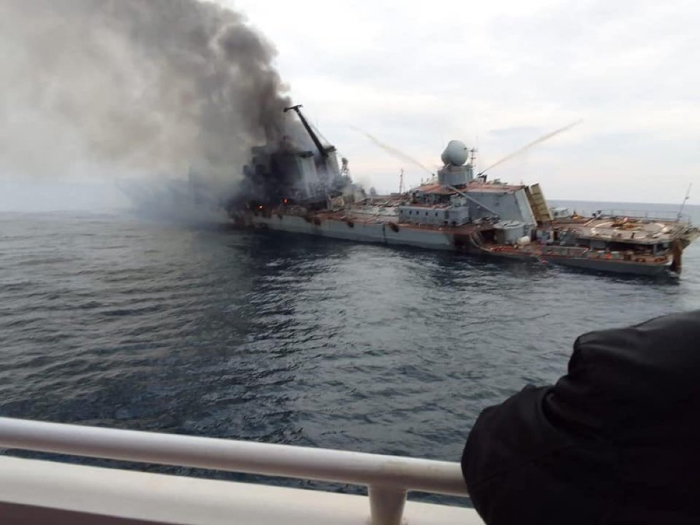
The security team arrived on board. For about 4.5 hours, their special forces conducted searches. Then they interrogated us on board for a day. They took all our gadgets. They said we would be taken to Crimea. I asked: What do you mean, to Crimea? When are you going to release us? He replied: either immediately or after the special operation. I ask again: how so? The operation can last for a month, two months, six months, or a year. Their senior says to me with a smirk: are you a priest? Six months or a year? Look at this power! And he points to the cruiser Moskva. It’s going to last 7-8 days at most.
Captivity and torture
V.V.: When the Russians saw that there were no weapons on board, they calmed down a bit. They put us on an armoured boat and took us to Crimea. They put us in the brig, where we stayed for 11 days. Constant interrogations and re-interrogations for 5 hours a day.
K.G.: What exactly did they ask you about?
V.V.: The main question I was constantly asked was about which department of the SBU I worked in [laughs – ed.] Tasks, intelligence, espionage – all the questions revolved around this. I should note that we were not physically tortured there, but they were constantly trying to put psychological pressure on us. We did not know what was happening in Ukraine. So we were told that Zelenskyy had already fled, everyone was surrendering, Russian troops had almost entered Kyiv, and so on.
After 11 days of interrogation of prisoners of war (although the Russians called them “detainees”), a really joyful event happened. Our rescue team saw the guys from Zmiinyi, who were thought to be dead. They were in captivity and were also in the occupied Crimea. But that was the end of any bright spots. All the prisoners of war – from Zmiinyi, Chongar, near Mariupol, civilians, about 200 people in total, were gathered in one plane and transported to Shebekino, Belgorod region of the Russian Federation.
V.V: In Shebekino, there was some kind of a tent city for prisoners, about 20-25 tents. We were the first to arrive there, and others began arriving. You can imagine: we left Odesa when the temperature was +8. When we arrived in Shebekino, it was -22. And we were all put in one tent, several dozen of us, in that cold. Intelligence and counterintelligence were already working there, and there were completely different interrogations.
At first, I did not realise the seriousness of the situation. They told me that if you cooperate, we are setting up a negotiation group with the Ukrainian military, and you will be in that group. I jokingly answered: Guys, I don’t mind, but I haven’t showered in 11 days, I smell bad, I can’t talk to Volodymyr like that. They said, “What Volodymyr? I answered: “The one that is Putin, of course.” This joke came back to bite me later. They pulled my hands behind my back and upwards, and then started hitting me with a rifle butt.
Before that, I thought that they didn’t need a priest, they would hold him and let him go. And then, for the first time, it became painful and scary. I had young guys in the tent, looking at me, and I was beaten and bleeding. They asked me: “What’s wrong?” And I said: “Nothing, they are Muscovites, they are such bastards, what can you do?” I was standing there, my legs were shaking, it hurt, I was scared, cold, and hungry (for the first few days, we were given only tea and undercooked rice porridge, which we could not eat), and there was a young boy, 24-25 years old, from the 35th Brigade, a marine, and there was no fear in his eyes, you know? And I pulled myself together, because how could I, an old priest, show this child that I was afraid of some Muscovite?
K.G.: As I understand it, the hell you went through began from that moment on
V.V.: Oh, they know how to torture – effectively and in different ways. They put me on a twine with my head close to the wall. It’s called stretching. One sits on you from one side, the other from the other, so the tendons start tearing. During this, you are beaten with tactical gloves or a baton on the kidneys and in the head. When they hit you in the head, you hit the wall with your face, your nose starts bleeding, and you’re covered in that bloody soup. During this, they could also beat you with a stun gun. They would try to hit you in the kidneys, genitals, or under the ear, so that you would immediately twist. The pain was so severe that words cannot describe it.
They threw me into a punishment cell. It was called “rezinka” (rubber in English). It was about +7 degrees inside. It was a room about 2.5 by 3.5 meters; there was no airing or ventilation, and everything was covered with rubber. There is no water, no toilet, nothing. They stripped you naked and threw you in there. And, of course, someone had been there before; someone used a room as a toilet for all kinds of needs. All this excrement was under my feet. The corresponding fumes began to corrode your respiratory system. In half a day, you start coughing up pus. And you can’t even sit down, you have to heat one place because it’s cold, and you stand there. I stayed there for 3.5 days without food, water, or sleep. After that, they take you for interrogation again, and they beat you again, and again with electricity, and again with a baton… They have learned how to torture.
They also blew up nails. When you’re on your knees, and your hands are behind your back, they start twisting your nails. One nail was blown up with a nail, and the other… There are such round-nose pliers. They put one sharp tip under the nail and twist it – one way and then the other.
K.G.: I realise the naivety of my question, but still: Did you tell them about the Geneva Convention, about the rights of prisoners of war?
V.V.: My friend… [laughs heartily – ed.] There are no rights, rules, or conventions there. They are subhumans. For centuries, there was assimilation, but we could not humanise them. They were a horde, and they still are. People ask me if I forgive them. Probably, yes. Because I am a Christian, I teach my parishioners to forgive. But I forgive not because I have to be kind to a Muscovite, but because I want to save a soul. Life is a moment before eternity. For the sake of eternity, we live here and go through these trials. And to avoid defiling our souls with anger and hatred, we have to forgive. God will punish them anyway. Perhaps with our hands. And the task of priests is not to let anger into our hearts so that our children do not grow up in a horde. So that we do not become them.
K.G.: I also have to ask you another trivial thing: were human rights activists or the Red Cross allowed to visit you?
V.V.: I once participated in an event where representatives of the Red Cross were present. I told them that they are like a unicorn. They asked me why. I said: “Because it seems so beautiful, everyone has heard of him, but no one has seen him. Similarly, no one has seen you in Russia. And in Ukraine, you walk around with a ruler and check how many centimeters the bed is from the wall, and how many calories are in the soup for Russian prisoners. Where were you when more than 50 Azovs were burned in Olenivka? Where were you when we were tortured in Russia? Why didn’t I see you there? There was no one there. For us, captivity was a slow death.
Returning home
The story of Father Vasyl’s exchange is still a mystery – even to him. It is only known that 12 times his release was disrupted for certain reasons.
K.G.: What do you know about the exchange that brought you back to Ukraine?
V.V.: To this day, I’m still terrorising Iryna Vereshchuk [Deputy Prime Minister and Minister of Reintegration of the Temporarily Occupied Territories of Ukraine – ed.] She doesn’t want to tell me. She says: “Only after the war, Father. It was very difficult with you. [laughs]. You shouldn’t have shouted “Glory to Ukraine!” in the detention center and sang “Chervona Kalyna.”
K.G.: Father Vasyl, summarizing our intense conversation, what would you say now, having survived captivity, having seen these almost 2.5 years of Russia’s full-scale invasion of Ukraine? Perhaps you have rethought some things, maybe you have started to look at something differently?
V.V.: We definitely have to win. We have to. If they take over Ukraine, they will not give us a chance. They will destroy everything connected with Ukraine. We don’t have time for any rest, any respite, everything must be for the sake of victory. And this applies to everyone!
Interview conducted by Kostyantyn Grechany