

Vladimir Putin has plunged the world into an abyss of lies, illusions and uncertainty. NATO leaders at this summer’s summit meeting in Washington should accept Ukraine as an associate member with the prospect of full membership, if Russia does not withdraw all its troops from all Ukrainian territory within the next two to three years.
Wien
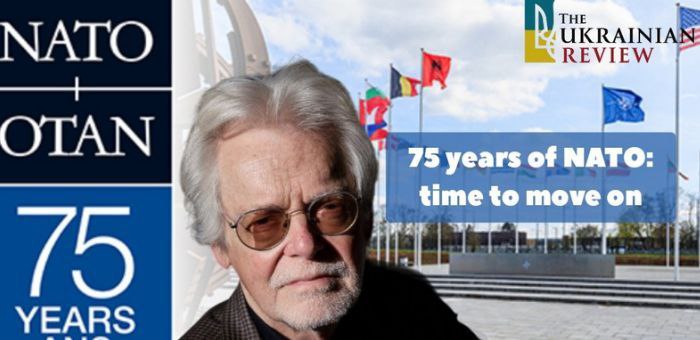
This Thursday marks 75 years since the foundation of NATO at a meeting in Washington, DC. Despite considerable initial pessimism, the North Atlantic Treaty Organization would prove to be the most successful defense and deterrence arrangement in history, a lasting security measure in contrast to the aggressive Warsaw Pact, which collapsed with the Soviet Union in 1991.
The original 12 NATO member states have expanded to become 32 members. Not all of them function perfectly. But that is not necessary. NATO is a military apparatus, not a moral court.
In its anniversary year, NATO matters more than it ever did during the Cold War between the West and then-communist Russia, which US President Reagan rightly called the Evil Empire. Soviet leaders recognised the need for military and political rules of the global game, and they could often be trusted. This is no longer the case. Vladimir Putin, the leader of fascist Russia and supreme military commander, has plunged the world into an abyss of lies, illusions, and uncertainty. Repeatedly violating the UN Charter and the Helsinki Agreement on Security and Cooperation in Europe, unleashing wars from Chechnya to Georgia and twice to Ukraine, accompanied by loud threats of a third, undoubtedly nuclear, world war, he has transformed NATO from a recently aimless and aging institution into a renewed instrument of vital importance to its members and to the maintenance of a world order, weakened by Moscow.
Nowhere is this weakening felt more clearly than in Northeast Europe, including Denmark with its responsibilities for the island of Bornholm, the transit waters between the Baltic and the Northern Oceans, and large parts of the Arctic. Following that the Russian war started in Ukraine in February 2022, all responsible authorities are on high alert, and mature public opinion is following suit. Finland and Sweden have stepped out of the shadow of neutrality and joined NATO with their significant defense capabilities. Scandinavia after years of comfortable inactivity under the US nuclear umbrella is now preparing for war, expanding its militaries and delivering lots of valuable material, including fighter planes, to help Ukraine, which is seen as a forward bulwark not to be lost.
x
This is not to say that everything is idyllic in NATO on the eve of the alliance’s July summit. Hungary, Turkey, and Slovakia are difficult partners. The leading European power, Germany, headed by Chancellor Scholz, plays a damaging role of indecisiveness. In seven months time the US will hold crucial congressional and presidential elections. Should the isolationist Trump win, he has already told Putin that he “can do, whatever he wants” with those NATO members, who do not pay, what he, the new and old tenant of The White House, may consider – without any legal basis – to be their proper due to the US. If Trump loses the election, which I think is likely, he has threatened a “bloodbath.” In the worst-case scenario, which is being considered from Washington over Brussels to Paris, Berlin, and indeed to Kyiv, there is a threat of civil war in America and a partial or complete neutralization of the United States in its role as primus inter pares of the Atlantic community.
If the Biden administration falls, it will provoke a global crisis in favor of Moscow and other gangster regimes. A terrible, very real possibility is that Biden wins the popular election, but in such a way that the undemocratically organized Electoral College can put Trump in the White House, a repeat of the 2016 scandal, when Hillary Clinton, a staunch Atlantic, and Democrat, received 66 million votes to Trump’s 63 million, where upon the loser was declared the winner and for the next four years ran a disastrous regime, courting outcasts such as Putin and Kim Jong Un in North Korea.
Europe is aware of the danger and is now arming itself, sometimes feverishly, sometimes systematically, but always insufficiently, not least in the case of the Ukraine war now, its first line of defense against Russian barbarism. Ukraine is no longer a borderland between East and West. With their heroic war – they effectively stopped what was considered the second strongest military power on the planet – Ukrainians have made it clear that they belong in Europe, from which Russia removed them during the Great Northern War in the 18th century.
The allies, at their July anniversary summit in Washington, should set a date for the start of concrete negotiations with the Kyiv government on Ukraine’s full membership of NATO, preferably with an initial assurance that if Russia does not withdraw all its troops from all Ukrainian territory within the next two to three years, such negotiations will be accelerated, and Western assistance to Ukraine will be expanded. French President Macron is on the right track when he proposes – after several failed attempts to reason with Putin – that NATO reinforce Ukraine with ground troops, not for frontline service, but for security missions in the hinterland, freeing Ukrainian soldiers for real combat. The fact that the allies do not supply Ukraine sufficiently – and that a scarred Chancellor Scholz in Berlin goes on denying Ukraine the strategically important Taurus missiles – clearly encourages the Kremlin, clearly prolongs the war, and clearly jeopardizes Europe’s security.
х
It will be a serious problem, if the United States, after a possible change of power in Washington, betrays its own defenses east of the Atlantic, but the problem is solvable over time, given the political will, which even now seems to be emerging. Europe has the strength to create its own defense, which can withstand a future, rearmed Russia. Europe has two nuclear powers, France and the United Kingdom, and can mobilize five to six million troops, including Ukraine’s war hardened army of about two million. Russia’s potential is limited to two, perhaps three million troops, Russia’s military technology is outdated, and its conventional weapons are so poor that the Kremlin is forced to buy drones, ammunition, and low-quality tanks from North Korea and Iran. The 30 European NATO countries, based on developed, efficient economies, produce an annual gross domestic product of just over 30 billion euros. Russia produces about two billion, equal to Italy, a third of which is lost in military and related activities. Europe can rely on half a billion well-educated and politically aware citizens. Putin has access to 140 million, mostly poor or semi-poor, and politically apathetic subjects. Russia is in a curve of slow decline, a superpower 50 years ago, today one of several great powers, long overtaken by China and even by India.
On this anniversary, we can thank the men and women, who 75 years ago gathered in Washington to sign the Atlantic Pact. We also need – in their spirit – to think of future challenges and future solutions.
By Per Nyholm
*These opinions are solely those of the author. The Ukrainian Review takes no position and is not responsible for the author’s words.
Per Nyholm has been a Danish journalist since 1960. He is based in Austria and is a columnist and foreign correspondent at the Jyllands-Posten, a liberal Danish daily newspaper.
Tetiana Stelmakh adapted this text for The Ukrainian Review.