

On October 1, 2024, Russian occupiers shot 16 Ukrainian prisoners of war in the Pokrovsky direction (Donetsk region). This was reported by the Office of the Prosecutor General.
The released video shows how, under the control of the enemy, captured soldiers of the Armed Forces of Ukraine left the plantation. After they lined up, the occupiers deliberately opened fire on them to destroy them. The wounded who showed signs of life were shot at close range with automatic weapons.
It was one of the most mass executions of Ukrainian prisoners during the full-scale war. In 2023, the shootings of Ukrainian military personnel became particularly frequent. Moreover, the Russians independently published and distributed video evidence.
One of the loudest examples is the case when, in March 2023, the Russians shot an unarmed Ukrainian soldier Oleksandr Matsievsky for shouting “Glory to Ukraine”.
Another reported fact of the killing of Ukrainian prisoners of war is the terrorist attack in Olenivka (a village in the Donetsk region) in July 2022. More than 50 people died, at least 140 were injured.
We will not recall all the facts of these Russian crimes against humanity, but we will quote Andriy Kostin, the Prosecutor General of Ukraine: “The killing of prisoners of war is a gross violation of the Geneva Conventions and an international crime”.
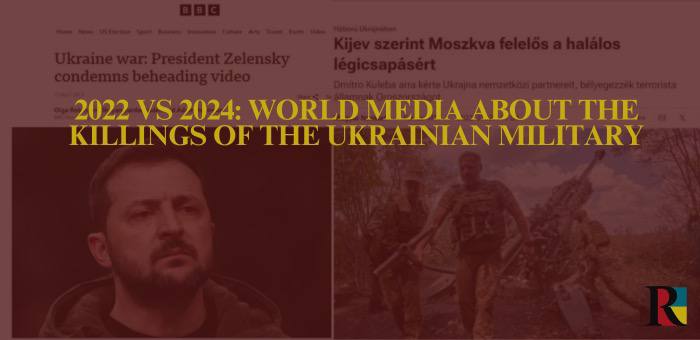
Next, we will analyse how the world media reacted to the shootings of Ukrainian military personnel by the Russians at the beginning of the full-scale invasion and now.
Independent investigations of crimes: American media
American media CNN has 74.96 million visitors in the last month.
The media published news about the terrorist attack in Olenivka, quoted the position of Russia and Ukraine regarding it and noted that “CNN was unable to independently verify the accusations of either side”. However, journalists “managed to geolocate footage of the attack”.
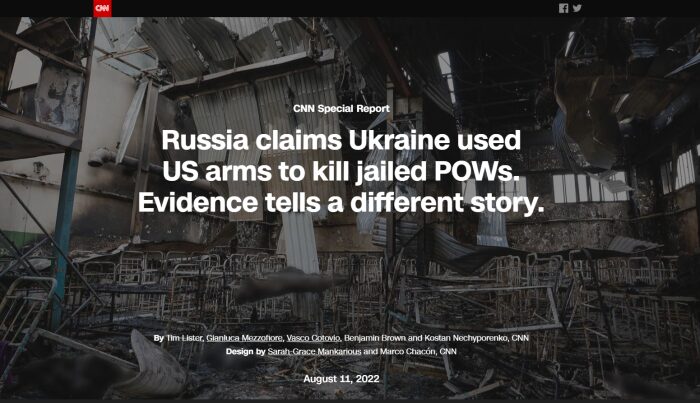
The media also published a separate article in which it was told about CNN’s investigation, based on the analysis of video and photos from the scene. Satellite images before and after the attack, as well as the work of forensic and weapons experts. CNN concluded that the Russian version of events is a very likely fabrication. There is virtually no chance that a HIMARS missile would have damaged the warehouse where the prisoners were kept.
In April 2023, the media published material about “a video showing the beheading of Ukrainian soldiers”. Journalists analysed this video and noted that one of the videos was probably taken in the summer (due to surrounding plants). The Institute for the Study of War is also quoted as saying that this is not the first such case, and the reaction of the Ukrainian authorities is given.
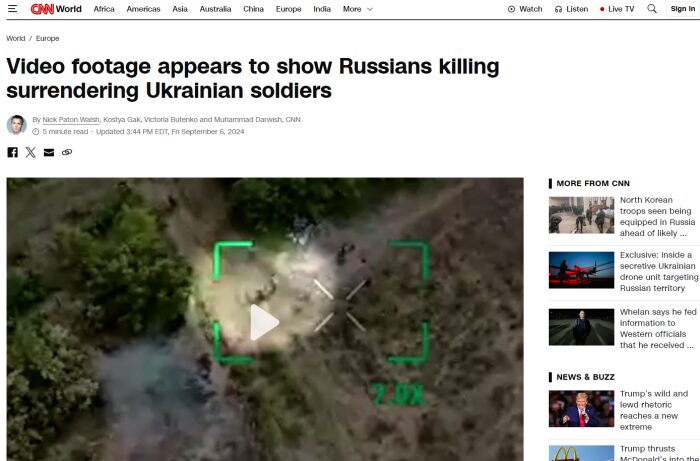
In 2024, journalists wrote about “a video showing Russians killing surrendering Ukrainian soldiers”. Note that the video is exclusive. The media quotes a military official who provided this video as saying that “their unit is aware of numerous similar cases (shootings of Ukrainian military personnel, – ed.) on the front lines, which were not made public or investigated”.
Journalists analysed that this case “is part of a pattern of apparent executions, the pace of which seems to have increased this year”. Prosecutor General A. Kostin is quoted as saying that these executions are a war crime. More recent similar cases are also being analysed.
Also, in this article, the media published this exact video, which had not been done before in publications.
Giving the floor to terrorists: British media
Media The BBC has 439.1 million visitors in the last month.
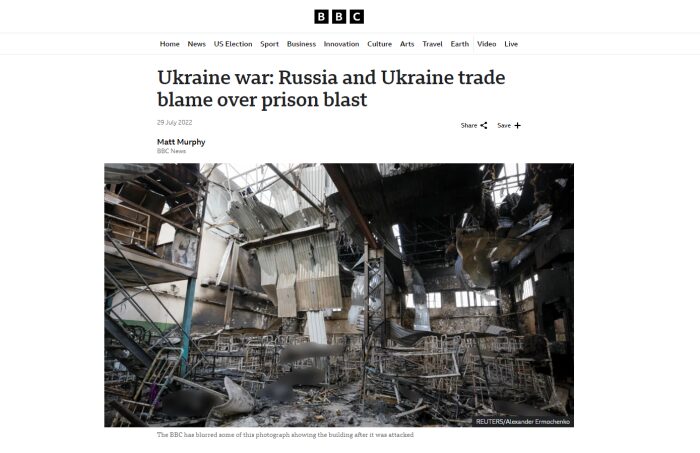
Regarding the terrorist attack in Olenivka, the BBC wrote that “Russia and Ukraine accused each other of shelling the occupied part of the Donetsk region with rockets, as a result of which dozens of Ukrainian prisoners of war were killed”. The journalists emphasised that the video from the events scene is “unverified”.
Journalists provide information and quote official representatives of all parties: Ukraine, Russia, and even the illegally formed Donetsk People’s Republic.
The media writes that “currently, there is little that can be done to verify these claims”. At the same time, he emphasised that Ukraine has a lot of evidence that it was Russia that committed the terrorist attack.
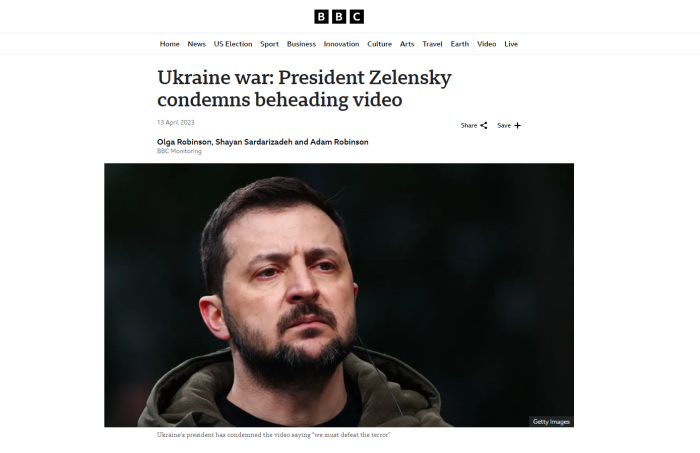
In another article about the beheading of a Ukrainian soldier in April 2023, journalists again provide information from all sides: the statement of the President of Ukraine, V. Zelenskyy, and the reaction of the Kremlin.
However, in this piece, the BBC has already analysed the video. They noted that military personnel who commit crimes have Russian identification marks, and speak Russian (although they note that many Ukrainians speak Russian) and analysed the uniform and identification marks of Ukrainian military personnel and their documents. It is also emphasised that the BBC journalists could not accurately identify either the geolocation of the video or the time of its filming.
That is, BBC journalists tried to maintain neutrality as much as possible and show information from “all sides”.
In this news story about the “shooting of captured servicemen by Russia in Kursk” in October 2024, the BBC emphasised that Ukraine condemns it. They noted that “Kyiv has repeatedly accused the Russians of executing captured Ukrainian servicemen, which is a war crime according to the Geneva Convention”. However, “the Kremlin denies the commission of war crimes in Ukraine”.
No analysis or attempt to identify the video has been made.
Emphasis on the UN: German media
Media Der Spiegel has 75.61 million visitors in the last month.
In the news about the terrorist attack in Olenivka, the journalists emphasised from the first paragraph that “military experts and former prisoners tend to believe in a targeted shooting”.
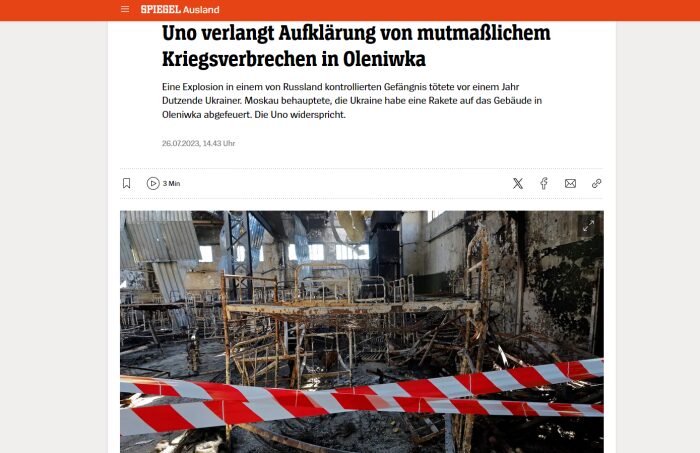
A year later, the newspaper published an article about the fact that the UN is still demanding an investigation into those events.
Journalists noted, “based on interviews with survivors and study of available materials, it was concluded that it “was not caused by the Himars missile”. At the same time, “the agency cannot determine the origin of the explosion or the exact direction from which the shooting could have been fired”.
In the end, Der Spiegel quoted Mykhailo Podoliak, adviser to the President of Ukraine, saying that “everything points to the fact that Russia deliberately organised mass murder”.
Immediately on October 1, 2024, the media wrote about “a video allegedly showing the killing of Ukrainian soldiers after their capture”. The publication quoted Ukrainian Prosecutor General A. Kostin. However, they noted that “there were no other sources about this process”.
In the end, Der Spiegel noted that “according to a recent UN report, soldiers on both sides are at the greatest risk of being mistreated or killed at the time of capture”.
Ignoring the news: Chinese media
Media People’s Daily has almost 407 thousand subscribers in the last month.
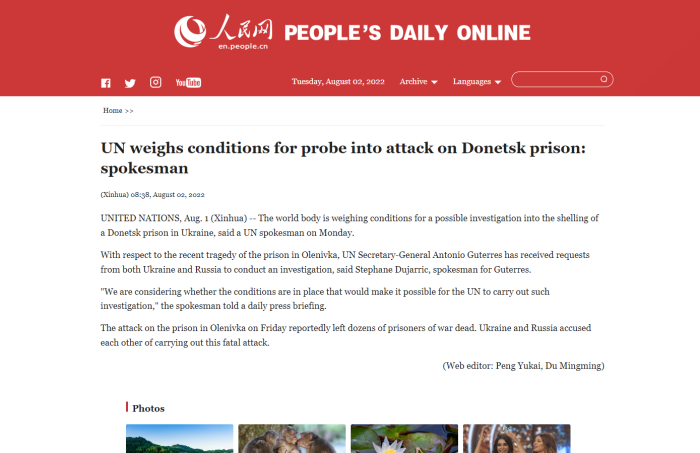
The media didn’t publish separate news about the terrorist attack in Olenivka, one wrote the news that “UN Secretary General Antonio Guterres has received requests from both Ukraine and Russia to conduct an investigation”.
No other details, analysis or recording of the circumstances of the event were specified.
Also, we did not find any other news about the shooting of Ukrainian servicemen by the Russians in Chinese media
Selective news coverage: Pro-Russian European countries
Serbian media Politika had 3.428 million visitors in the last month.
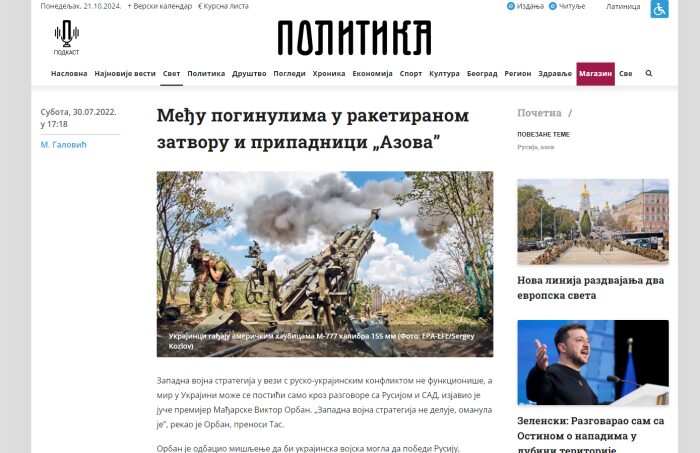
In the news about the terrorist attack in Olenivka, the media wrote that “the warring parties blame each other.” The media presented information from both sides: accusations of Ukraine and accusations of Russia. However, it did not provide more analysis and presumptive evidence, as other media have done.
We also note that the news began with a quote by the Prime Minister of Hungary, V. Orban, that “peace in Ukraine can only be achieved through negotiations with Russia and the USA”.
There is no news about the shooting of Ukrainian soldier Oleksandr Matsievskyi or news about the beheading of a Ukrainian soldier.
At the same time, Politika published news about the murder of 16 Ukrainian prisoners of war in 2024. The publication quoted Ukrainian officials and noted the fact that this violates the Geneva Convention.
Hungarian media Magyar Nemzet has 7.225 million visitors in the last month.
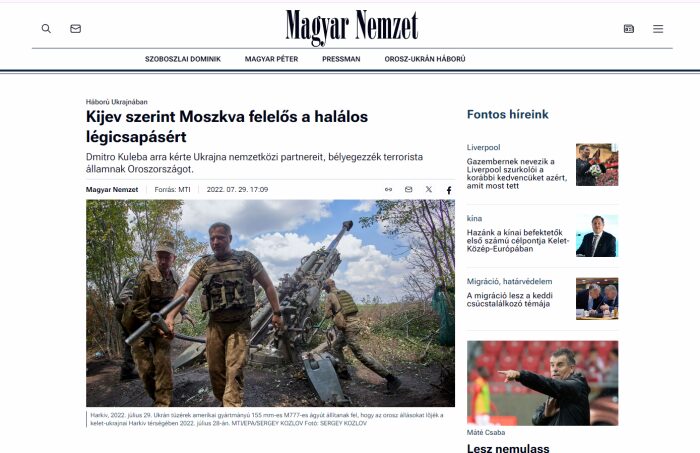
The media published news about the terrorist attack in Olenivka. Journalists noted Russia’s accusations, but provided information from Ukrainian officials who denied it. However, no other analysis, evidence, or reaction of the world was provided.
As in the Serbian media, we did not find any other news about the killings of the Ukrainian military in 2023.
In 2023, only V. Zelenskyi’s statement was published that “the case regarding the mass murders of Ukrainian soldiers in the Olenivskyi camp of the Donetsk region will become one of Russia’s charges in the international tribunal”.
Also, we did not find any publications about the latest high-profile murder of 16 Ukrainian soldiers in the Pokrovsky direction.
***
At the beginning of the full-scale war, the media was mainly limited to general statements from both sides and unconfirmed data, emphasising the difficulty of verifying information. Some media did their own investigations to confirm the truth.
In 2024, the media continues to publish news about Russian crimes, but the number of journalists’ own investigations has decreased. Which may indicate fatigue or getting used to such news. Also, some frankly pro-Russian media, on the contrary, publish news about the shootings of Ukrainian military personnel by the Russians selectively and infrequently.
In October and November, The Ukrainian Review is launching a new information campaign called #NoPeaceWithoutJustice to highlight the facts of brutal violence against Ukrainian prisoners of war, including executions. During this period, the publication will publish a series of materials detailing Russia’s violations of international law and the Geneva Conventions, as well as highlighting the facts of executions and ill-treatment of Ukrainian prisoners of war.
This material is part of a series of such texts that will be available on our website under the hashtag #NoPeaceWithoutJustice.
Anya Ostymchuk